

Despite a stricter abortion law that took effect in July 2023 — limiting most procedures in North Carolina to 12 weeks of pregnancy and requiring two in-person appointments separated by a 72-hour waiting period — the Tar Heel state is still a key access point for abortion care in the Southeast.
For the third consecutive year, North Carolina served the second-highest number of out-of-state patients in the country — behind only Illinois — according to a new report on national abortion volumes.
Of the nearly 48,000 abortions provided in North Carolina in 2025, more than one in three — about 37 percent — were for people traveling from states where they were no longer able to get them, according to estimates released last week by the Guttmacher Institute, a national organization that tracks trends in reproductive health.
That amounts to 17,890 abortions obtained by out-of-state residents in 2025, up from an estimated 16,220 in 2023 and 17,120 in 2024.
In 2020, before more restrictions on abortion access were added to state law, North Carolina had a total of 31,850 procedures.
The share of abortions for out-of-state patients has held steady at just over one-third since 2023 — more than double the 17 percent of patients who came from elsewhere in 2020.
That demand reflects North Carolina’s geography: It is the closest option for many people in the South. Most other states have either near-total bans or do not allow abortion past six weeks in pregnancy — a point at which many women don’t yet know they’re pregnant.
“North Carolina remains a really critical access point, particularly in the Southeast,” said Guttmacher Institute data scientist Isaac Maddow-Zimet, who leads the organization’s Monthly Abortion Provision Study. “That’s really clear from this data — that it’s playing a really critical role for folks who want or need in-person care. We saw that role accelerate after Florida’s six-week ban [took effect in May 2024] and it seems to be sustained in 2025.”
The sustained level of travel to North Carolina is somewhat surprising, Maddow-Zimet said, given the state’s 72-hour waiting period and requirement for two in-person appointments, which can be challenging logistical hurdles on top of long travel distances. Nationwide, interstate travel for abortion is declining, according to Guttmacher data: In 2025, about 142,000 people traveled across state lines to obtain an abortion — down from 154,000 in 2024 and 170,000 in 2023.
“It’s really notable that there’s still so many people traveling to North Carolina,” Maddow-Zimet said. “For many folks in Florida and in other states in the Southeast, North Carolina is just the place that they have to go to get in-person clinic care, and it’s by no means close for a lot of people. For somebody living in Florida, it could be a trip of 500 miles or more.”
While many patients travel for care to states that are less restrictive than where they live, others are increasingly turning to telehealth for medication abortion as the way people get abortion care has shifted since the Supreme Court’s June 2022 Dobbs decision overturning Roe v. Wade.
Growth of abortion via telehealth
Nationwide, there were an estimated 1,126,000 clinician-provided abortions in 2025, according to Guttmacher — the most provided in the United States since 2009, though still well below the historical peak of about 1.6 million in 1990. The Guttmacher numbers undercount the total number of abortions because they do not include self-managed abortions — people using medications at home without initiating contact with the health care system.
While the majority of these abortions occurred in person, a growing share were obtained through telehealth from clinicians in states with telehealth shield laws. Eight states — including California, Massachusetts and Colorado — have laws that explicitly protect clinicians using telehealth to provide abortion remotely by mailing abortion pills to patients in states that have total abortion bans or other restrictions.
In December 2021, the U.S. Food and Drug Administration eased restrictions on the abortion medication mifepristone by eliminating the in-person dispensing requirement. That change expanded access, including by allowing the drug to be mailed. (Studies show that abortion provided through telehealth is as safe as in-person care.)
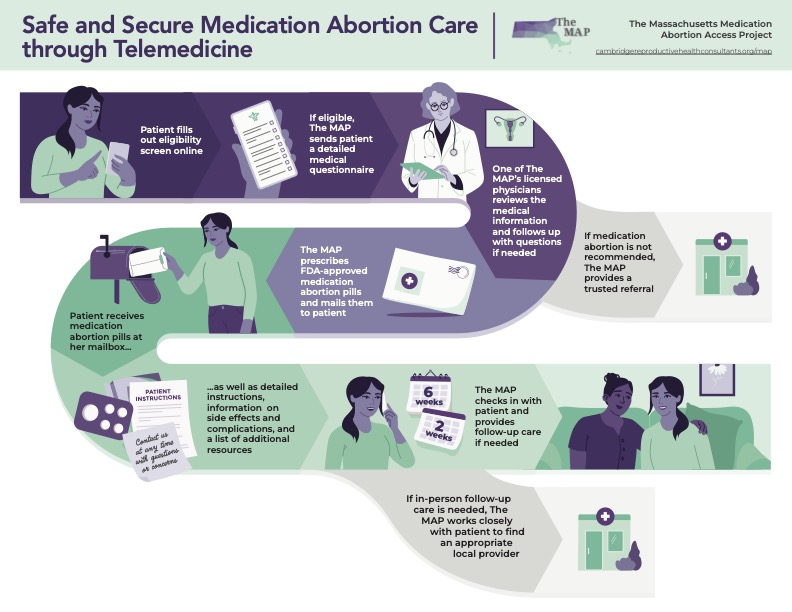
Angel Foster, founder of The Massachusetts Medication Abortion Access Project, is a shield law provider. The organization mails a two-drug abortion regimen to patients up to 11 weeks after their last menstrual period in all 50 states — including North Carolina — after a licensed clinician reviews medical information.
The organization operates on a pay-what-you-can model, with a minimum payment of $5.
“There is this sort of assumption that it’s an automated thing — that people are just sending pills to everyone — but there’s actually a whole process that’s happening that’s very much akin to what happens when you get in-person care,” Foster said. “It’s what’s happening within a lot of different fields of telemedicine, not just abortion care.”
In the first six months of 2025, 27 percent of the 591,770 abortions obtained in the U.S. health care system were provided through telehealth, according to the latest #WeCount report, an abortion data collection effort led by the Society of Family Planning. By June 2025, nearly 15,000 abortions per month were provided under shield laws, accounting for more than half of total telehealth abortions.
North Carolinians are among those using telehealth shield law protections. It’s the only way for patients in the state to access telehealth abortion care, since state law adds restrictions beyond the FDA’s rules, requiring all medication abortion pills to be dispensed in person by a physician after a 72-hour waiting period and state-mandated counseling.
In the first six months of 2025, about 18 percent of total abortions in North Carolina were obtained by telehealth through shield law providers, according to #WeCount data.
The number of patients getting care this way has steadily increased since July 2023 — when the state’s stricter abortion law took effect. That month, 250 telehealth abortions were reported. By June 2025, the monthly number had grown to 730.
“It’s becoming even more attractive as a mode of care, because it’s so much less expensive and less onerous than in-clinic abortion care,” Foster said. “It’s so much more affordable than traveling out of state to a brick-and-mortar facility somewhere else if you’re in a state with a near-total ban or a gestational age restriction.”
Since launching in September 2023, Foster said demand has continued to grow. The organization serves 3,000 to 3,500 patients a month, including 130-140 from North Carolina, she told NC Health News.
“We can’t care for people who age out of the 12-week ban,” Foster said. “So for us, the patients that we’re seeing from North Carolina want telemedicine care because that’s their preferred model. It could be that it’s less expensive, and it may be that folks are having a difficult time accessing brick-and-mortar facilities.”
A shifting abortion landscape
Though the role of telemedicine in abortion care continues to grow, Foster said that in-person options are still vital.
“There are always patients who are going to need to go to a brick-and-mortar facility — whether that’s patients in the first trimester of care who aren’t eligible for medication abortion, or really don’t want a medication abortion, and certainly for patients who are beyond the first trimester — especially as we get into later gestational ages,” Foster said. “With this shift towards telemedicine, how can we make sure that we still protect and fortify our clinics so that we have that as a continued part of the landscape?”
North Carolina has just over a dozen abortion clinics spread over nine counties offering in-person abortion care. Still, some North Carolinians travel to Virginia or other states with broader access — including in cases of fetal anomalies, in which North Carolina’s law isn’t clear-cut.

According to Guttmacher data, 2,250 North Carolinians traveled to Virginia for abortion in 2024, making it the most frequent out-of-state destination. The number of North Carolinians who sought care there in 2025 has not yet been released, though providers say Virginia is still a key option because it does not have a waiting period and allows abortion through the second trimester of pregnancy.
“Everybody’s situation is really specific and unique, and people are weighing a lot of complicated factors when they’re deciding whether they’re going to travel for care or whether they access care through telehealth,” Maddow-Zimet said.
This article first appeared on North Carolina Health News and is republished here under a Creative Commons Attribution-NoDerivatives 4.0 International License.