
2026 North Carolina Primary Election

Julian Berger
/
WFAE
Mecklenburg County Sheriff Garry McFadden held on to a narrow lead in his race for a third term in Tuesday’s Mecklenburg County Democratic primary.

Steve Harrison
/
WFAE

Mecklenburg County
/
Livestream
-
 The seat is held by Republican Addison McDowell. He faces the Democratic mayor of High Point, Cyril Jefferson. This race features two of the youngest candidates running for U.S. Congress in North Carolina. As of June 2026, McDowell has raised more than $1 million for his campaign versus Jefferson’s $157,000. The Cook Political Report estimates that this district leans Republican by 9 percentage points.
 -
 As November's midterm elections draw near, immigrant advocacy organizations in North Carolina will activate voter hotlines in multiple languages and deploy poll monitors to help voters and watch for unusual activity.
 -
There are 50 members in the North Carolina Senate, and they serve as the "upper house" of the General Assembly. Their powers include proposing and passing laws, along with the state House; fiscal oversight of the state budget; gubernatorial veto overrides; confirmation of certain executive branch appointments; redistricting; proposing N.C. constitutional amendments and providing constituent services. State residents must be at least 25 years old to run for the Senate, and they must have lived in N.C. for at least two years. State Senators serve two-year terms with no term limits.
-
District 73 is located in Cabarrus County, encompassing suburban and small-town communities northeast of Charlotte.Incumbent Jonathan Almond ran unopposed in the Republican primary. On the Democratic side, primary candidate Kim DeLaney passed away in January 2026, leaving Thomas Monks as the sole Democratic nominee without a contested primary. Key issues include inflation and cost-of-living relief as well as public education funding.
-
District 82 is in Cabarrus County, covering a mix of suburban Concord/Harrisburg-area communities and more rural parts of the county.
-
Republican incumbent Grant Campbell, a physician and Army veteran, faces Democrat Johnnie Jones after Democrat Cortez Ferrell withdrew from the race.
-
Cabarrus County Commissioners are the chief administrative authority in the county and are responsible for determining the strategic vision and direction of the County. The Commissioners are responsible for setting policy, adopting the annual budget, establishing the tax rate, overseeing operations (including roads, bridges and public buildings) and hiring the county manager. The five-member board serves staggered four-year, at-large terms. Three Republicans are facing three Democrats and a Libertarian candidate in the general election in November 2026. There are three seats up for election; only one incumbent, who was recently appointed, is on the ballot. The county’s overall budget is more than $400M. The county is currently working on ways to reduce a projected deficit of more than $13M for the budget for fiscal year 2027.
-
Cabarrus County voters will be asked to vote on three bond referendums in this election totaling $440 million. This brochure from The Chamber, Leading Business in Cabarrus (which is a sponsor of The Election Hub) provides more detail about how public education is funded and the role that bonds play in educational funding in general and within Cabarrus County.
-
The Cabarrus County School Board of Education sets standards, policy and goals for the district, hires the superintendent, approves the budget, ensures accountability for student achievement and oversees instructional materials and curriculum. The Board consists of seven members who serve staggered four-year terms. There are three seats on the board that are up for election this year.
-
 Voter ID requirements are already in state law. In November, voters will decide if the mandate should be in the state constitution.
 -
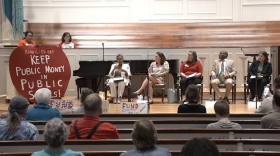 North Carolina voters will decide whether state lawmakers set limits on how much local governments can increase property taxes. Counties use that revenue to pay for services like education.
 -
 Election board members who shared fringe theories and disinformation now make decisions on elections administration.


