

After spending six months examining the state’s involuntary commitment process, a special North Carolina House committee released a list of recommendations on Tuesday aimed at improving the state’s intertwined mental health and criminal justice systems.
The House Select Committee on Involuntary Commitment and Public Safety formed after the passage of Iryna’s Law late last year and has met monthly to hear presentations from state department officials, law enforcement and hospital leaders, as well as other researchers and experts. They also solicited and received a significant amount of public comment on potential reforms.
Iryna’s Law was passed quickly in response to the fatal stabbing of 23-year-old Iryna Zarutska on a Charlotte light rail train in August 2025. The man charged with her killing has a history of mental illness and incarceration, which prompted lawmakers to look at what could be done to prevent future tragedies and get people with severe mental health issues the help that they need.
Though Iryna’s Law was the impetus for the committee, lawmakers also sought to address decades-old problems that have been festering in the mental health system. Their recommendations touched on many parts of the system, from the lack of staffing at the state psychiatric hospitals to the lack of data about the involuntary commitment process.
Committee co-chair Rep. Timothy Reeder (R-Ayden) said Tuesday that the committee’s recommendations reflect short and long-term goals, some of which he hopes will result in legislation during the upcoming session slated to begin later this month.
“This is a big issue that has taken decades to get to where we are today, and so we’re not going to solve it in the few months that we’ve had,” Reeder, an emergency department physician, said. “But we want to continue to make incremental steps forward.”
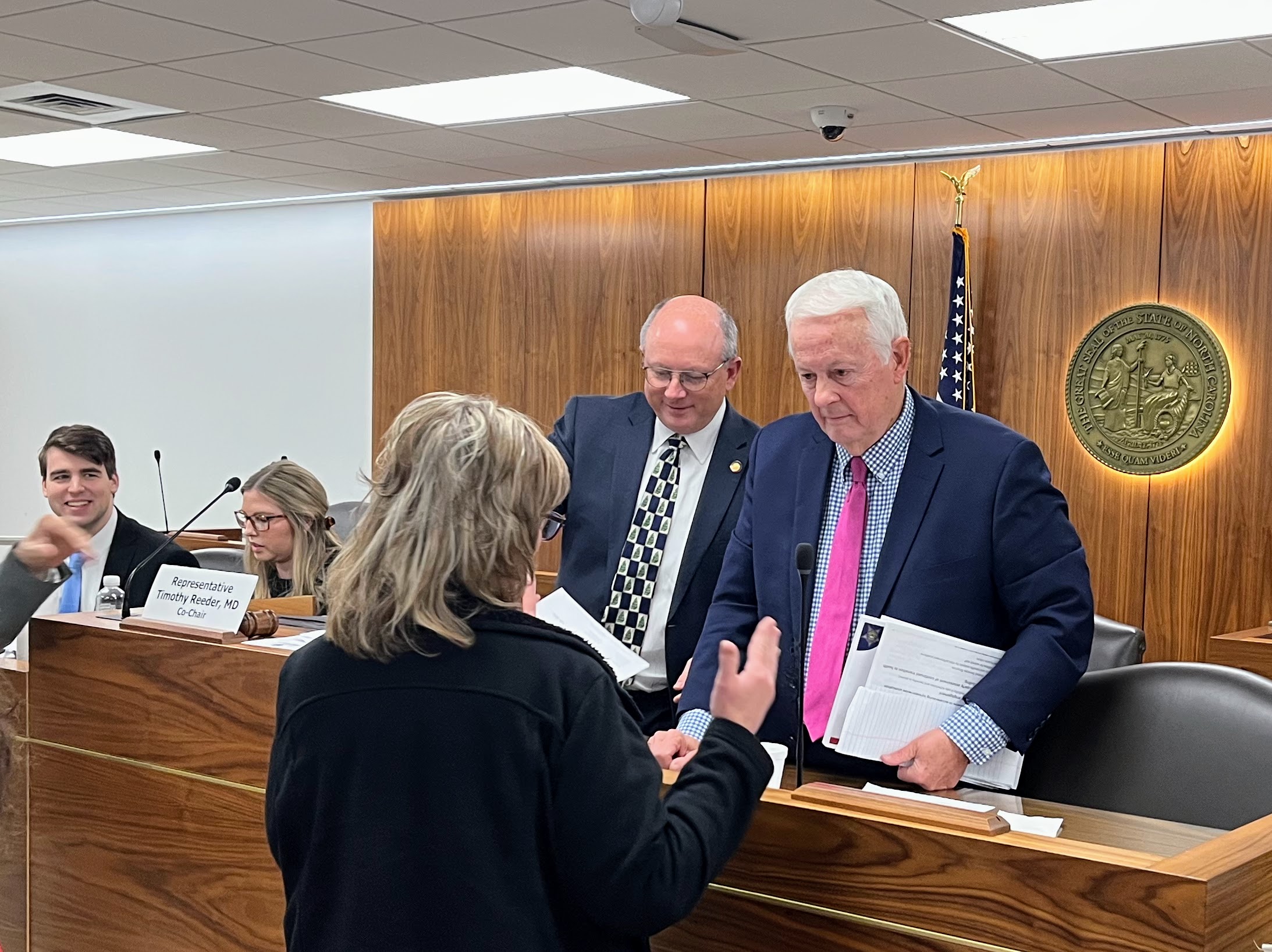
The report recommends that the committee keep meeting through the calendar year and be reestablished in the next long session — an extension of its original scope of work.
“One of the advantages of continuing the committee is that we can continue to sound the alarm and push these things specifically to the extent that we don’t get them done in the short session,” said co-chair Rep. Hugh Blackwell (R-Valdese).
“There’s a lot of stuff that needs to get done,” he continued. “So we need to plan to walk and chew gum at the same time and move several things. The Senate is interested in these issues, and we have some good opportunities.”
In addition to getting their Senate counterparts on board, committee members from both sides of the aisle acknowledged that more money will be needed to implement some of their recommendations.
Adjusting Iryna’s Law
The 42-page report’s most time-sensitive recommendation calls for revising a provision of Iryna’s Law, which will take effect in December.
The law requires that people who are arrested for crimes and also meet specific mental health criteria be evaluated to determine if they should be involuntarily committed for psychiatric treatment. As written, Iryna’s Law requires law enforcement officers to take criminally charged people to an emergency department for a psychiatric evaluation if the officer determines the person has mental health issues, or if the person is charged with a violent offense and has been subject to an involuntary commitment order within the past three years.
The requirement prompted swift pushback from hospital leaders, who warned the House committee that bringing criminally charged patients to already overcrowded emergency departments would put too much strain on staff and pose a safety risk to other patients. The North Carolina Sheriffs’ Association voiced opposition to jails taking on a greater mental health role by conducting these evaluations inside their facilities.
Lawmakers ultimately decided that these exams should not be done in hospitals, but in jails.
In their report, lawmakers recommended shifting evaluations to a telehealth model conducted in jails to help address “long wait times to see providers, transportation issues, logistical issues, and safety concerns.” That will require an amendment to Iryna’s Law — something lawmakers say they plan to pursue in the upcoming short session — along with state funding to build telehealth capacity in all county jails.
Eddie Caldwell, executive vice president and general counsel of the North Carolina Sheriffs’ Association, said sheriffs are “comfortable” with the recommendation.
“The jail would put the inmate in front of the camera and dial in to the state doctor, or the state-funded doctor, who would then conduct the examination,” Caldwell said. “A whole lot won’t need done on the jail side to implement this once the resource is available.”
Under the proposal, jail staff would simply facilitate the connection — similar to their role in getting incarcerated people to appear for virtual court hearings — rather than shoulder the load of health care staffing or costs.
Caldwell emphasized that sheriffs have long opposed proposals that would shift additional health care costs to the counties or require jail staff to function as mental health providers. But he said the committee’s recommendation avoids those issues by keeping responsibility for care and funding at the state level.
Host of recommendations
The committee report outlined about a dozen other recommendations, including drafted bill language for a proposal to collect more data on how patients move through the involuntary commitment process.
Currently, North Carolina doesn’t track or report data on the number of requests for involuntary commitment and the outcomes for those patients. The report recommends that the N.C. Department of Health and Human Services and the Administrative Office of the Courts examine how to collect and report more meaningful data.
Among the other recommendations:
- Review the legal standards for involuntary commitment, incapable to proceed and adult guardianship to identify places to enhance effectiveness and public safety
- Authorize more providers to conduct involuntary commitment examinations by amending state statute and evaluating current training programs
- Revise state outpatient commitment laws and ensure that there is funding in place to increase its use
- Address staff vacancies and bed shortages in state-operated psychiatric facilities by reviewing staffing models and hiring and retention practices
- Establish a working group led by DHHS to address the “revolving door problem” of people with mental health issues — especially those with repeated nonviolent misdemeanors — cycling from hospitals to jails to the community
Several of the recommendations require action from DHHS. A department spokesperson said staff are still reviewing the committee report and its recommendations, and that they are “grateful for the collaboration with the NC General Assembly as we both work to increase access to care for people in mental health crisis and involved in the justice system in North Carolina.”
The department spokesperson also pointed to a report published in February outlining DHHS’ recent work to improve access to mental health care and bolster the workforce across the state.
During the Tuesday committee discussion, Rep. Marcia Morey (D-Durham) praised the report and asked that the committee not lose sight of the fact that many of the problems the committee has identified will need “a good sizable chunk of funding.” She noted that hundreds of beds within the state’s psychiatric facilities stay empty because there aren’t enough staff to operate them, and she urged her colleagues to consider more funding for them.
Reeder pushed back, saying that the legislature has allocated funding for the state psychiatric hospitals, but they’ve struggled to find people to fill the positions. Reeder said he and others on the committee recognize that there will need to be additional funding to accompany some of the recommendations in the report. But the amount will have to be negotiated between the state Senate and House of Representatives amid their prolonged budget stalemate.
Iryna’s Law was initially criticized by some for not allocating more funding for mental health services across the state. Mental health experts told NC Health News that what they believed was urgently needed was more upstream, community mental health resources to prevent mental health issues from spiraling into criminal involvement.
Members of the public echoed these sentiments in their comments to House lawmakers.
Public weighs in on needed reforms
Dozens of public comments from health providers, advocates, community members and people with lived experience of mental illness painted a dismal picture of a system that is failing people.
“We are already overrun with behavioral health patients to the point we cannot provide adequate care for emergent medical conditions,” wrote an emergency department nurse from Davie County. “I am ashamed at how poorly NC has responded to the mental health crisis.”
A psychiatric nurse in Orange County wrote that he left his position on a community mental health team because he believed the system was too broken.
“I was witness to the tragically unfortunate revolving door and subsequent poor outcomes that lead patients to lose all faith in themselves and in the system,” he wrote.
There was agreement across the nearly 100 comments submitted online that more needs to be done, including earlier interventions to prevent people from going into crisis or from deteriorating into a much worse state.
“What I am seeing is a system that waits,” wrote a Wake County resident. “We wait until someone is in crisis. We wait until there is danger. We wait until it is too late.”
The committee’s recommendations don’t focus on upstream services, rather after someone has had a mental health crisis and/or involvement in the criminal justice system.
Meanwhile, opinions were split on how to best fix the problems. Some called for building more psychiatric units, expanding involuntary treatment and implementing 72-hour holds for people with psychosis who refuse medications. Others warned that coerced treatment does more harm than good.
“Locking people in psychiatric hospitals has a well known long standing history resulting in abuse, neglect, human rights violations and re-traumatization,” wrote a peer support advocate from Charlotte. “To use the most restrictive and least humanizing approach to public health creates a false illusion of safety.”
Many commenters called on the lawmakers to invest more in the state’s mental health system and its workforce.
“There is a demonstrated need for additional mental health practitioners, nurses, and support staff in both public and private hospitals in NC,” wrote a Winston-Salem resident. “The State must first address the existing staffing and facility issues to meet current demand […] Both increasing position salary and increasing the number of positions will likely be needed.”
“You can’t expect a system you don’t fund to work,” another commenter wrote.
As the next legislative session is set to begin next week, lawmakers will not only have to pass their proposed reforms; the bigger challenge could be paying for them.
This article first appeared on North Carolina Health News and is republished here under a Creative Commons Attribution-NoDerivatives 4.0 International License.