


The Tar River flows peacefully on an early spring afternoon. Katey Zimmerman sits on a wooden dock meant for kayak and canoe launches. As she gazes out over the river, the water reflects in her sunglasses.
"Water is a finite resource, especially freshwater," said Zimmerman, the Pamlico-Tar Riverkeeper with the nonprofit Sound Rivers.
She's been spending a lot of time in this area lately, organizing against a proposed data center in Edgecombe County that would use 900 megawatts of energy - enough to power about half a million homes.
The proposal would get its water from Rocky Mount, which gets its water from the Tar River. A few feet behind Zimmerman, rushing water spews from a large, concrete pipe. It's discharge from a nearby wastewater treatment plant run by the city.
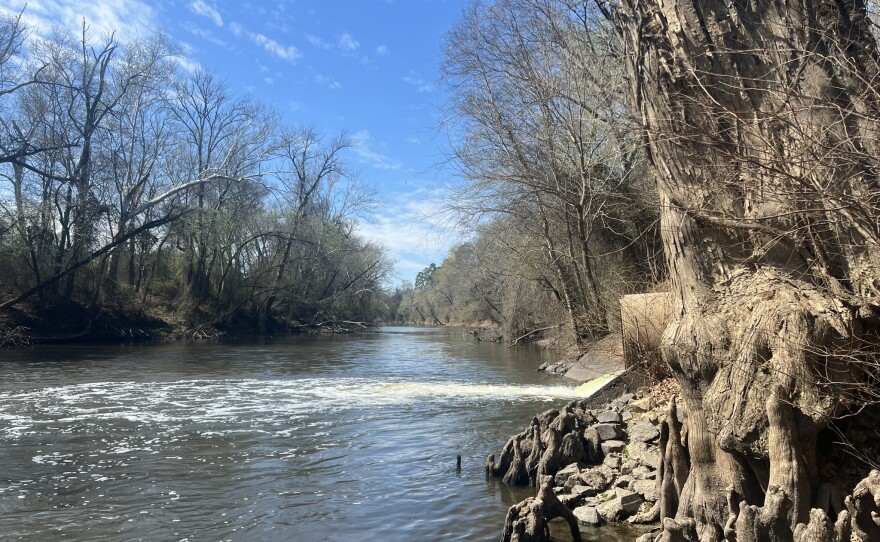


"I'm concerned over what (this project) means for water availability in the Tar River," Zimmerman said. "We don't have any concrete information or details from the company about how much water they plan to use."
The project developer, Energy Storage Solutions, "has indicated an estimated usage of approximately 500,000 gallons per day," according to Edgecombe County Manager Eric Evans. He also noted the County "has paused consideration of this project until the company provides sufficient evidence that it has secured the necessary financing to move forward."
Energy Storage Solutions did not respond to a WUNC News request for comment.
In this 6-part series, BPR, the NC Newsroom, WFAE, and WUNC explore North Carolina's accelerating data-center boom and its real impact on local communities.
Through on-the-ground reporting, document reviews, and conversations with residents, the series examines how Big Tech is reshaping small towns, consuming vast amounts of power, and striking deals that aren't always clear. It explores who benefits, who bears the cost, and why North Carolina has become an appealing target for server farms despite modest public scrutiny. By following the money, the energy demands, and the promises made to communities, the project aims to reveal what's at stake as the cloud moves into the state’s backroads.
Zimmerman isn't alone in her concerns. Across North Carolina, different communities are raising similar concerns over how data centers impact local water utilities, water quality, and water availability.
Big tech companies - including Meta, Google and Microsoft — have all committed to replenishing more water than they consume through water sustainability practices and local water stewardship projects.
Water quality: PFAS can be introduced during cooling process
Data centers use water in a number of ways: to power energy facilities — like coal plants; to supply energy to data centers; and to manufacture computer chips.
But the metric Tar Heel communities told WUNC News they’re most worried about is how much water data centers will need for cooling. Data centers can use different kinds of cooling systems, depending on various factors. These cooling systems are critical to make sure computing equipment doesn’t overheat or malfunction.
Zimmerman said one issue is how data centers can inadvertently create water pollution.
"There are a lot of concerns over specific contaminants that are introduced to the water during the cooling process," said Zimmerman.
Some data centers use PFAS in their cooling process. PFAS, also known as forever chemicals, are already widespread in other North Carolina waterways, like the Cape Fear River. These chemicals have been linked to negative health effects, including decreased fertility and increased risk of some cancers.
"It seems like there would be the possibility of PFAS being discharged into the Tar River, which is what we don't want to see," said Zimmerman.
It's unclear, though, how prolific PFAS are among data center cooling systems, according to Jonathan Kalmuss-Katz, senior attorney with Earthjustice. He explains the use of PFAS by data centers is under-reported and under-studied.
"Can I point to an example where this data released (this) PFAS to this utility? No, but that doesn't mean it's not happening," said Kalmuss-Katz. "That just means that there's not enough information and not enough disclosure about what these data centers are actually releasing."
Water availability: 'Climate change is removing the safety net from our water supplies'
The entire state of North Carolina is currently in moderate to extreme drought. This dry spell began last August and worsened over the winter.
Climate change is making rainfall more unpredictable, according to Assistant State Climatologist Corey Davis. That means it's harder to replenish water sources like aquifers or reservoirs.
"Climate change is really removing the safety net from our water supplies," said Davis. "A reservoir operator may not know whether they need to keep the water levels higher in case of a drought, or lower in case of heavy rainfall."
Davis described a phenomenon he calls "weather whiplash."
" It's when you go from these extreme wet periods to extreme dry ones with almost no warning. The wet periods tend to mean (that) when it rains, it pours," he said. "You're getting very heavy rain amounts in a very short time period. And then in between those heavy rain periods, it's getting drier faster. So in terms of what these future changes will look like (because of climate change), we're already seeing some of those now."

Another problem: During those heavy rainfall periods, rain can pool up and never actually make it down into the ground to replenish groundwater resources.
Population growth is another factor to consider when it comes to water availability, Davis added.
"Over the last 100 years North Carolina's population has more than quadrupled," said Davis. "So then when you add in things like data centers, that are not people but machines, that are consuming more water, certainly that adds to the stress that water systems can face."
Local water utilities: Balancing tech needs with providing residents clean, drinking water
The amount of water that data centers consume depends on several factors, such as size, location, and what type of cooling system they use.
For example, Meta operates a 30-megawatt data center in Forest City in western North Carolina. That facility used about 4.2 million gallons of water all year in 2024.
In Wake County, developers were proposing a 300 megawatt data center in Apex. The project was cancelled in March, but it was slated to use up to 1 million gallons of water per day, with one-third of that evaporating and not returning to the Cape Fear River.

The way Jonathan Jacobs, Apex’s water resources director, was planning for this project provides valuable insight since data centers depend on local utilities for water. The facility would have used treated wastewater, which is different from drinking water, Jacobs explained.
"We have been very firm on no domestic water to protect our finite drinking water resource there at Jordan Lake," said Jacobs.
Jacobs said while he’s responsible for providing water for residents of his town, he also has to consider the impact on downstream communities.
"Fayetteville and Harnett County are all dependent on our wastewater stream just as much as we are from Burlington and Greensboro and all the towns upstream from us that provide water to the Haw River that feeds into Jordan Lake," said Jacobs. "We want to make sure that our downstream partners are getting the anticipated return that we always intended to serve the (Cape Fear) basin."
As Jacobs points out, water connects everything. This interconnectedness will continue to guide local choices, which must find a delicate balance between fast-moving tech growth and limited natural resources.
