

Kristen Jarrell, an Alexander County resident and licensed foster parent in Wilkes County, has had a dickens of a time trying to find a dentist for children in her care.
In North Carolina, one of the requirements for a child entering foster care is a health and emotional trauma screening that includes an oral health assessment. For any needs identified, the state Department of Health and Human Services requires follow-up care and monitoring.
“What that looks like in real life is hours of phone calls, being told over and over ‘We don’t take Medicaid’ or ‘We’re not accepting new patients,’” Jarrell said Tuesday during a news conference at the State Legislative Building in Raleigh. “And if you do find someone, you’re often waiting weeks to be seen.”
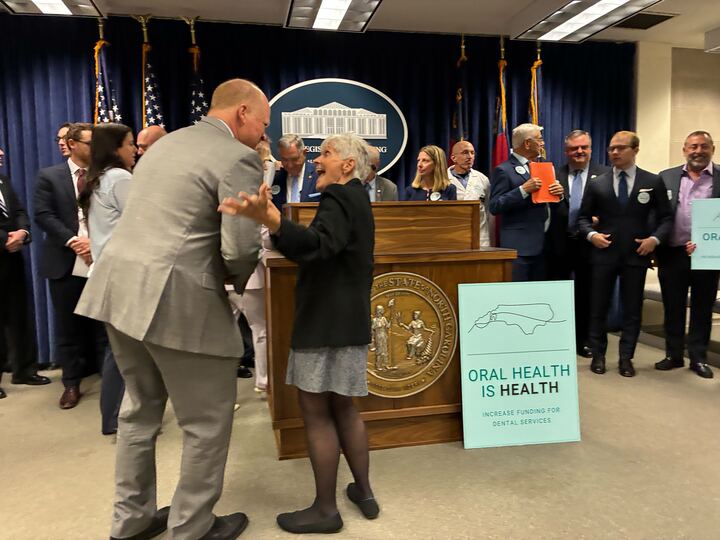
Jarrell was among a group of oral health advocates and lawmakers Tuesday who have renewed a push to increase the Medicaid reimbursement rates paid to dentists as a way to improve access for patients.
Currently, the Medicaid reimbursement rate for dentists is about 34 cents on the dollar, the same that it was in 2008. Three state senators — Gale Adcock (D-Cary), Jim Burgin (R-Angier) and Kevin Corbin (R-Franklin) — introduced a bill on Tuesday that would appropriate $80 million from the state general fund to the state Department of Health and Human Services to significantly boost the reimbursement rate. The new rate would be closer to 50 cents on the dollar, Adcock said.
Only about 45 percent of the dentists across North Carolina accept Medicaid patients, in large part because the reimbursement rate does not sufficiently cover the treatment costs.
“Dentists cannot pay their bills on what Medicaid pays,” Corbin said. “Other states around us — Virginia, Tennessee, Alabama — have increased those Medicaid rates. This has led to a 20- to 30-percent increase for the number of private dentists accepting Medicaid within three years, and that has been a good thing.”
Jarrell would like to see the same thing happen in North Carolina.
“I had a child placed in my care who needed extensive dental work. It took weeks just to get an evaluation, and then more weeks to get him scheduled for surgery at a surgery center over an hour and a half away from our home,” she told reporters and others gathered for the news conference. “That’s not just inconvenient. That’s a child living in pain while we wait.”
Jarrell added that access to oral health care “shouldn’t come down to luck, distance or whether a provider is willing to accept a child’s insurance.”
“We need more providers who can afford to accept Medicaid. We need reimbursement rates that reflect the actual cost of care so that dentists can say yes to these kids. Because right now, there are too many saying no.” Jarrell added. “These children deserve timely, quality dental care no matter their background, no matter their insurance. The people caring for them need a system that works with us, not against us.”
‘In crisis’
There’s been an effort for several years to not only increase the Medicaid reimbursement rate for dentists, but to also raise awareness about the issue.
In December 2023, after Medicaid access was expanded to cover 690,000 more people, Frank Courts, then chair of the North Carolina Dental Society Council on Oral Health and Prevention, wrote a letter to the editor published in Neuse News and other publications, describing the North Carolina Medicaid dental provider network “in serious crisis.”
Courts echoed that sentiment Tuesday.
“Access to Medicaid oral health care is in crisis, particularly in rural areas. And there’s a lot of those in North Carolina,” Courts said at the news conference. “The dental care network is in decline throughout the state because the cost of care is often not covered by the reimbursement levels.”
Data from the Sheps Center for Health Policy Research at UNC Chapel Hill shows that 21 rural North Carolina counties have fewer than two dentists for every 10,000 residents. There are four counties — Gates, Camden, Tyrrell and Hyde — that have no dentist at all.
The state’s Medicaid program offers comprehensive oral health benefits, such as routine cleanings, exams and other preventive services. For care deemed “medically necessary,” that also includes some oral surgeries, periodontal care, tooth restoration, denture fittings and placements.
Lack of access to that care is why Courts and others are adamant about trying to fix the system.
Detailed road map
A 2024 report compiled by the North Carolina Institute of Medicine shows that in 2022, 14 percent of services to Medicaid beneficiaries were dental procedures, but only about 2 percent of the spending on Medicaid payments went to dental providers.
Increasing the dental reimbursement rate could help cut down on other Medicaid spending by catching oral health problems before they require visits to the emergency room, speakers at the news conference said.
“Dental decay is by and large a preventable disease. Almost all dental problems can be prevented,” Courts said. “Prevention and early treatment are key factors in the control of this disease. Without this care, the cost of treatment becomes dramatically higher, and the health outcomes become much worse.”
Poor oral health is a significant risk factor in cardiac conditions, diabetes, dementia and a myriad of other medical conditions, Courts added.
Oral health is commonly described as an integral component of overall health, not just a separate concern.
“Without oral health, you’re not going to have a healthy body,” Courts said.
If dental care is not available, Courts said, severe pain can erupt from tooth decay and other oral ailments. That can lead to sleepless nights, an inability to chew, missed school and work, or an inability to concentrate in classrooms. If the disease progresses long enough, he added, it can result in infections that can be life-threatening.
“Hospital emergency rooms are where people end up,” Courts said. “The care usually results in an antibiotic, pain medication, but does not address the underlying disease.
And the cost is often between $1,800 and $2,000 for that visit. And when the antibiotics wear off and the medication is gone, they’ll end up in the E.R. again, and it’s a waste of resources and not a good way to deal with oral health.”
The Institute of Medicine report provides a detailed road map to address the “medical oral health crisis,” Courts said.
“The citizens of North Carolina deserve a Medicaid oral health system that addresses prevention, early treatment and the dental destruction caused by chronic disease,” he added. “Importantly, the system will be critical in mitigating the serious medical conditions that are associated with poor oral health. This bill will be a giant step toward achieving that goal.”
‘Never the perfect time’
Adcock acknowledged challenges ahead with a financially-related bill in a state where key Republican lawmakers in the state House and Senate are locked in a stalemate over spending priorities for a biennial budget that was due last year by July 1.
“What we know is there’s never the perfect time to do this, but there’s an opportunity with every session,” Adcock said, giving a nod to the tenacious advocates for Medicaid expansion who waited for 10 years to see the fruits of their labor take effect.
“We are not going to let the conversation die down,” Adcock said. “We are not going to be quiet. We’re not going to go home. We’re going to continue to ask for this until such time as it becomes reality because here’s what we believe: Everything looks impossible until it becomes inevitable.”
Crystal Adams, director of the N.C. Oral Health Collaborative, an organization that has advocated for higher reimbursement rates for several years, also stressed the importance of staying in the fight for the long haul, however long that might be.
“We’re not going to give up,” Adams said. “We’re going to keep fighting the fight until somebody gives us a positive answer. Then we’ll go home.”
If there’s success getting a higher rate, Adams added, there will also be an additional hurdle: trying to persuade providers to come on board.
“’We would love to do an oral health campaign,” Adams said. “We would love to have someone educating providers. There’s a lot of myths about Medicaid.”
Some dental practices have shied away from Medicaid, she said, because they say they don’t want to deal with additional paperwork related to the government subsidised care. She tried to dispel that complaint.
“One of the things we hear from our providers — they tell us Medicaid’s one of the first checks that arrives at their offices,” Adams said. “They pay fast, but they don’t pay enough.”
Adams, other oral health advocates and the bill sponsors at the State Legislative Building Tuesday envision a day when all that will change, and they plan to do more than hope for a new horizon.
“Hope is not a strategy,” Adcock said. “Hope that somebody down here will wake up and say, ‘We should do that?’ We’re the people saying, ‘We should do that.’”
This article first appeared on North Carolina Health News and is republished here under a Creative Commons Attribution-NoDerivatives 4.0 International License.