

Key takeaways:
- More than one-third of North Carolina jails have exceeded capacity at some point in 2026, with 19 operating above capacity every month this year.
- Sheriffs and jail administrators cite stricter pretrial release rules, prison transfer delays, slow-moving courts and gaps in behavioral health care as drivers of the increase.
In North Carolina’s largest jail, hundreds of people sleep on the floor on portable bed platforms.
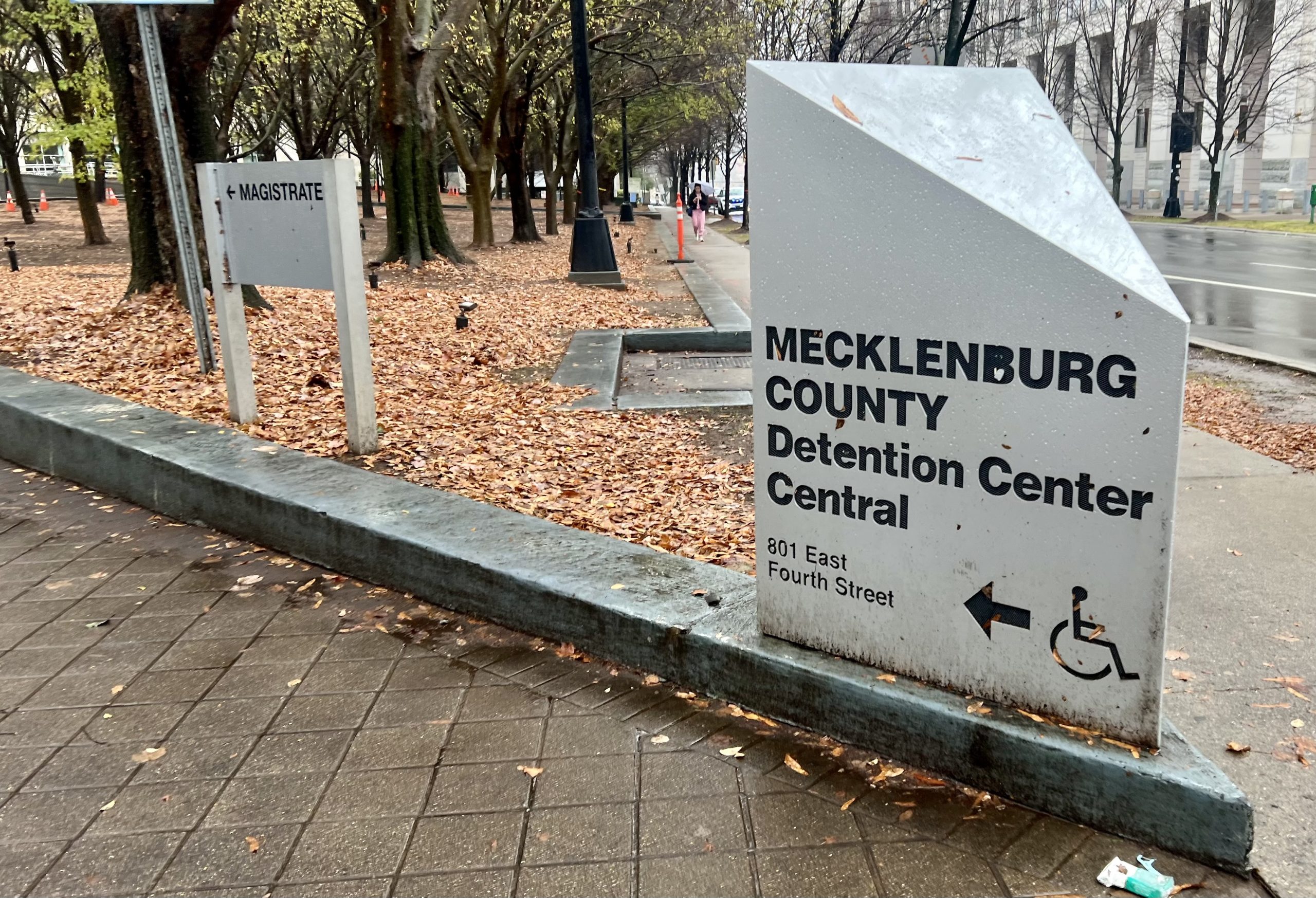
As of July 16, 2,146 people were in custody in Mecklenburg County’s uptown Charlotte jail — 242 people above the jail’s capacity of 1,904. Pods designed for 53 people now routinely hold as many as 84, Sheriff Garry McFadden told NC Health News.
Mecklenburg isn’t alone. As sheriffs and jail administrators across North Carolina monitor their daily population counts, many are confronting a similar problem: jails that are near or beyond capacity.
State data show that at least 36 jails — more than one-third statewide — have operated above capacity at some point so far in 2026, according to a NC Health News analysis of a July 14 confinement report showing the average monthly population in each county jail. Another 17 have come close, reaching at least 90 percent of capacity.
Statewide, the average monthly jail population reached at least 22,543 people in April, the highest monthly average since at least January 2024, according to NC Health News’ analysis of data.
Sheriffs and jail administrators attribute the rising jail populations to many factors, including North Carolina’s population growth, gaps in community mental health and substance use treatment resources that can land people in jail, and slow-moving court cases that can keep people in jail longer. They also point to Iryna’s Law, which took effect in December and limits the use of pretrial release for certain defendants, as further straining jail capacity by keeping more people in jail longer.
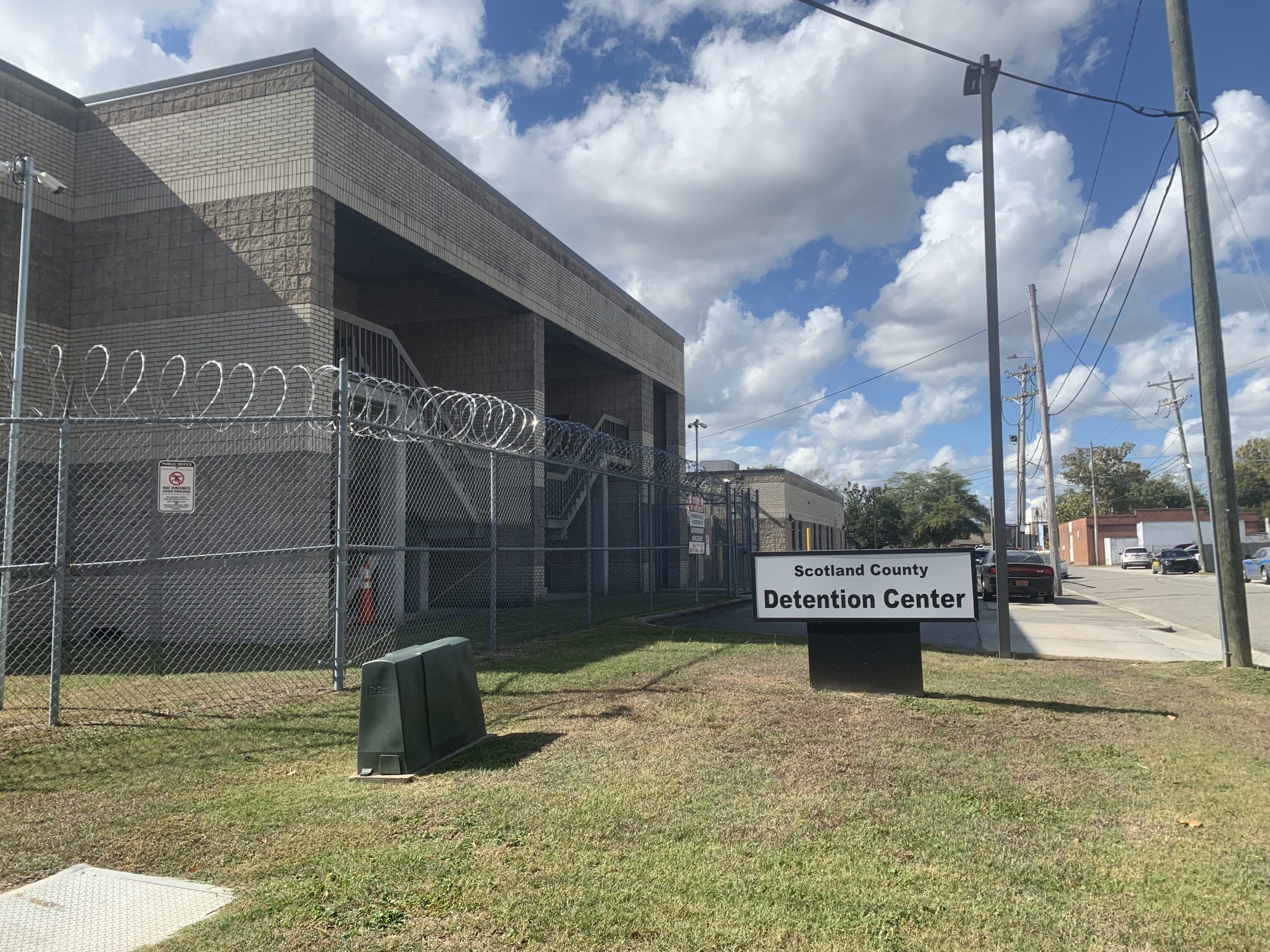
Scotland County Jail Administrator John Hunt told NC Health News the jail regularly holds about 180 people — well above its capacity of 109. Many cells with bunks designed for two people now house three people, with one sleeping on a mat on the floor. In recent months, Hunt said he’s had to order more mats, uniforms and food to keep up with the growing population.
But there’s only so much space. State data show Scotland County has the state’s most overcrowded jail, averaging about 160 percent of capacity so far this year. Its average monthly population rose from 116 in January 2024 to 194 in June 2026.
The Robeson County Detention Center is also overflowing. Designed to hold 410 people, Maj. Ryan Howard told NC Health News on June 1 that the jail had a population of 508 people. Another 53 people connected to the county were being housed elsewhere — either in one of five other county jails with space or in state prison as a “safekeeper,” which is someone who poses security risks or requires a higher level of medical or mental health care than counties can manage.
Robeson’s jail has exceeded its capacity every month since at least January 2024, making it one of the most chronically overcrowded facilities in the state based on NC Health News’ analysis of jail population data. So far this year, the jail has operated at an average of 123 percent of capacity.
“It’s an everyday struggle,” Howard told NC Health News.
Overcrowding isn’t new for many jails. After jail populations dropped during the COVID-19 pandemic, they have steadily rebounded in many counties — stretching facilities to and beyond capacity.
“The numbers just keep going up,” Hunt said about Scotland’s jail population.
Scope of overcrowding
North Carolina has 98 jails operating across 93 counties, with a combined bed capacity of 25,838. Thousands of people cycle in and out of them every year; some spend only a few days behind bars, while others remain for weeks, months or even years either awaiting trial or serving sentences.
The N.C. Department of Health and Human Services maintains an annual confinement report that tracks each jail’s average monthly population, providing a snapshot of capacity and overcrowding.
During the first half of 2026, 26 jails averaged more than 100 percent of capacity. If the pace continues the rest of the year, that will be more than the 16 jails in 2025 that averaged over 100 percent occupancy.
Of the one in three jails that have exceeded capacity in at least one month in 2026, many weathered consecutive months of overcrowding. Nineteen jails have exceeded capacity every month in 2026 for which state data is available.
Some jails exceeded capacity by only a handful of people, while others housed dozens more than they were designed to hold.
Luke Woollard, an attorney at Disability Rights North Carolina, has tracked jail populations and inspections for years to ensure that people with disabilities in local jails receive proper treatment. He told NC Health News he’s increasingly concerned about overcrowding across the state, particularly with an uptick in jail deaths.
Woollard said a jail doesn’t have to exceed its capacity to become unsafe. Another important factor to consider is staffing — a number not captured in the statewide confinement report.
“If you have a serious staffing shortage, you might as well be overcrowded,” Woollard said. “Yes, to some degree, it is what the building can hold, but before that becomes a problem I would say really when we talk overcrowding, what we’re talking about is safe staffing ratios.”
As an example, Woollard pointed to the June 29 takeover at Bertie-Martin Regional Jail in Windsor, where some of the 88 incarcerated people overpowered the three correctional officers on duty — a typical level of staffing for the jail — and took two of them hostage. The jail has a capacity of 90, and state data shows that the average monthly population has remained below capacity this year. Based on the population count alone, Woollard said the jail wouldn’t necessarily raise concern.
Woollard said North Carolina has no statewide mandatory staffing ratio for jails, allowing staffing levels to vary across the state, particularly as some counties struggle to recruit and retain correctional officers.
Vivian Saunders, chairwoman of the Bertie-Martin Regional Jail Commission, told Bertie County commissioners on July 13 that three to four correctional officers working per shift to supervise the population is normal. She said the jail currently employs just 14 correctional officers.
Scotland County is also facing staffing pressures. Sheriff Ralph Kersey addressed his county commissioners on July 6, after the Bertie hostage situation, about his jail’s dire staffing levels and the risks posed to staff and those in custody. He said his jail houses more than double the number at Bertie-Martin Regional Jail — yet has the same number of officers working each shift.
“Right now with four officers with 189 inmates, that’s 62 inmates assigned to one person,” Kersey told commissioners.
He said just 20 people are assigned to work at the jail and that he needs at least six more officers to keep up with the larger population.
Increases in jail populations can quickly strain detention centers. Every incarcerated person requires food, clothing, a bed and medical care — costs that add up quickly and demand more staff to handle daily operations, security rounds and services.
“I’m just asking for some help,” Kersey said. “We’ve got serious problems over there,” he added, referring to staffing gaps, along with the aging infrastructure of the jail.

McFadden, Mecklenburg County’s sheriff, is upfront that overcrowding deteriorates the conditions at his jail — with people sleeping atop portable platforms on the floor and dozens more people sharing the limited number of showers, toilets and phones. He also said tensions can flare with more people in tight quarters, placing staff and those in custody at greater risk.
“No time is really a good time to come to jail, but if you come to jail now, you will be here for a while, and accommodations will be even worse,” McFadden said.
While overcrowding is a common problem, not all North Carolina jails are over capacity. Twenty-two jails operated at less than 70 percent of their capacity, on average, during the first half of 2026.
Lauren Earnhardt, executive vice president of the North Carolina Sheriffs’ Association, said some counties — which are responsible for funding jails — have prepared better than others by investing more in their jail space and staffing than others.
Iryna’s Law takes effect
Sheriffs and jail administrators say one of the newest factors adding pressure on jail capacity is Iryna’s Law, which took effect in December in response to the fatal stabbing of 23-year-old Iryna Zarutska in August on the Charlotte light rail. The man accused in her killing has a criminal history and severe mental health challenges, prompting lawmakers to scrutinize gaps in North Carolina’s mental health and criminal justice systems.
The law requires magistrates and judges to apply stricter criteria when weighing release decisions for people charged with violent offenses, or for those who have been charged with a Class 1 or higher misdemeanor three times within the past decade. Class 1 misdemeanors include offenses such as breaking and entering, drug paraphernalia possession and criminal trespassing.
The law also eliminates the option for defendants to be released on a “written promise to appear” and requires judicial officials to make written explanations for release decisions.
Supporters, including the North Carolina Sheriffs’ Association, argued that the law would improve public safety by keeping more people in jail and breaking the cycle of quick releases followed by repeat offenses. At the same time, several sheriffs warned it could further strain already crowded detention centers.
Mecklenburg’s sheriff was among those who voiced concerns. Since the law took effect, McFadden said his jail population has swiftly climbed to the highest level he’s seen since he became sheriff in 2018. The jail’s population has climbed from its monthly average of 1,530 in November 2025 — the month before the law took effect — to an average of 2,016 by June 2026, an increase of about 32 percent.
McFadden acknowledged the law isn’t solely responsible for driving the growth.
Six months ago, McFadden said, several housing pods sat empty. Now, not only is every pod full, many are overcrowded.
In response to what he describes as “unprecedented overcrowding,” McFadden announced in May his plans to reopen Mecklenburg County Jail North — a 721-bed facility — later this summer. Jail North most recently housed juveniles before closing in 2022 because of staffing shortages at the county’s adult jail.
Wake County Sheriff Willie Rowe said in a statement to NC Health News his jail population has also risen, exceeding the combined capacity of the county’s two detention facilities, which have 1,574 beds.
In June, the monthly average population was 1,736 — 162 people above capacity. He attributes some of the population growth to more people being held in custody without bond due to stricter pretrial release rules under Iryna’s Law. On Dec. 1, when the law took effect, about 198 people were held in custody without bond. By April 21, that number had more than doubled to 424.
Earnhardt of the North Carolina Sheriffs’ Association said the direct impact of Iryna’s Law on statewide jail populations is still not clear, and she’s not aware of any formal analysis that has examined it.
Prison logjam
Another factor sheriffs and jail administrators frequently say contributes to capacity strains is the backlog of people who have been sentenced but continue occupying space in county jails while waiting to be transferred to the state prison system to serve their time. As of June 23, 1,432 people were in county jails because the N.C. Department of Adult Correction didn’t have room and/or staffing for them at state prisons.
Chronic correctional officer staff shortages have prevented the prison system from taking more people into its custody, Keith Acree, the department’s communications director, said in a statement to NC Health News.
He said staffing shortages have forced the department to close 4,686 beds at 17 prisons — about 12 percent of the prison system’s total capacity.
Meanwhile, Acree said an increasing number of convictions from the courts have slowly grown the backlog over the past year.
Acree said that people that have been on the backlog longest are generally transferred to prison first, though the department works with sheriffs’ offices “when special issues arise.”
As of June 23, the department also housed 199 “safekeepers” for county jails, and Acree said those placements occupy beds that would otherwise be available to admit people into prison.
Expanding jail capacity
For overcrowded jails, there’s not much relief in sight.
“Sheriffs are in a tough spot,” Earnhardt said. “The sheriff cannot decline to take people into the jail. They’re required by law to accept whatever comes to the jail door that cannot make bond, and so the options for a sheriff are pretty limited … They’re really at the mercy of the court system, and that’s a really hard place to be.”
In Robeson County, Howard, the jail administrator, reviews the population daily, looking to identify anyone who can safely be moved. He works with the county district attorney to see if there are options to speed up court proceedings, consider electronic monitoring or adjust bonds for people who don’t pose a danger.
Those efforts can temporarily ease crowding, Howard said, but relief is often short-lived as new people enter the jail.
Howard and other jail administrators facing overcrowding also lean on other counties with available bed space to house some of their detainees. But finding space at other jails has become increasingly difficult as more facilities fill up and have less space to offer. When beds are available, they may be hours away, creating transportation challenges for court appearances.
As overcrowding persists, many counties are building — or planning to build — larger jails.
In the past two years, Haywood, Randolph and Wayne counties have completed jail expansion projects, while eight other counties have construction projects underway, according to DHHS data provided to NC Health News.
More counties are discussing construction projects, including Scotland, Richmond, Union and Carteret.
Kersey, Scotland County’s sheriff, pleaded with county commissioners earlier this month to move forward with expanding the jail — whether through renovations and an addition, an entirely new jail, or even a regional jail shared with Richmond County. While Kersey is leaving office in five months after not seeking a fourth term, he said the issues with the jail aren’t going away.
Woollard cautioned that building larger jails isn’t a “silver bullet” for capacity challenges.
“You can’t just build your way out of it,” Woollard said. “You also need staffing for these facilities, and these facilities take a while to build.… You might end up just transplanting your staffing issues from one facility to another.”
Beyond building new, larger jails, Woollard said counties should look at upstream strategies to reduce the number of people entering jail in the first place, including non-police behavioral health response teams and diversion programs for low-level offenses.
Sheriffs and jail administrators frequently note that many people entering jail have mental health and substance use disorders that contribute to their involvement in the criminal justice system.
“There are inadequate resources for mental health and substance abuse treatment, and so a lot of those people end up in jail who shouldn’t be there in the first place,” Earnhardt said. “If there was better mental health treatment in our state or a place that those people could go and be secured, then the jails also would not be as crowded.”
This article first appeared on North Carolina Health News and is republished here under a Creative Commons Attribution-NoDerivatives 4.0 International License.