
Chapel Hill-Carrboro City Schools' state funding could be in jeopardy because Republican lawmakers believe the district is not fully complying with the Parents Bill of Rights.
That law, passed in 2023, requires schools to notify parents to consent to a slew of matters relating to their kids. Most controversially, the bill requires schools to notify parents if their child changes their name or pronoun at school. It also bans any teaching about gender, gender identity or sexuality before fifth grade.
For their part, Chapel Hill-Carrboro Schools officials maintain that they are following the 2023 law in its entirety, a contention Rep. Mike Schietzelt, R-Wake, called "bureaucratese." Schietzelt sits on the House Oversight and Reform Committee, which was hearing testimony from Chapel Hill-Carrboro School Board Chairman George Griffin and Superintendent Rodney Trice.
When Chapel Hill-Carrboro Schools crafted its Parents Bill of Rights policies in early 2024, it decided not to change district policy to include language requiring that parents be notified if their kid has changed their name or desired pronouns.
Instead, it opted to address the matter in guidance issued to teachers and staff. WUNC reported at the time that school board members acknowledged they would likely face legal challenges over the policies.
Still, Griffin said Wednesday, "I can say with 100% certainty that we, as a district, are complying with the law."
He was under questioning from Schietzelt at the time, who shot back, "I can tell you with 100% certainty that you are not, Doctor, and it is offensive for someone to come before this body and say, 'we are complying with the law' when there are videos, there are documents, there is a mountain of evidence that you are not."
Recent outrage about the Chapel Hill-Carrboro policies started with the right-wing X account "Libs of TikTok," which on Oct. 23 posted a video of Griffin describing how the district's policies were intentionally defying the Parents' Bill of Rights. That video came from a September school board candidates' forum.
The school board, Griffin said at the forum, thought the gender and sexuality provisions of the Parents' Bill of Rights were "blatantly discriminatory."
"The board voted just to tell the General Assembly, 'No thanks, we're not doing this.' It was risky, it was out there, but we were trying to make a statement as well as protect our kids and our families," Griffin said.
Crafting a policy that managed to both hew to Chapel Hill-Carrboro's values and abide by the law would legitimize the policies that board members viewed as discriminatory, Griffin went on to say.
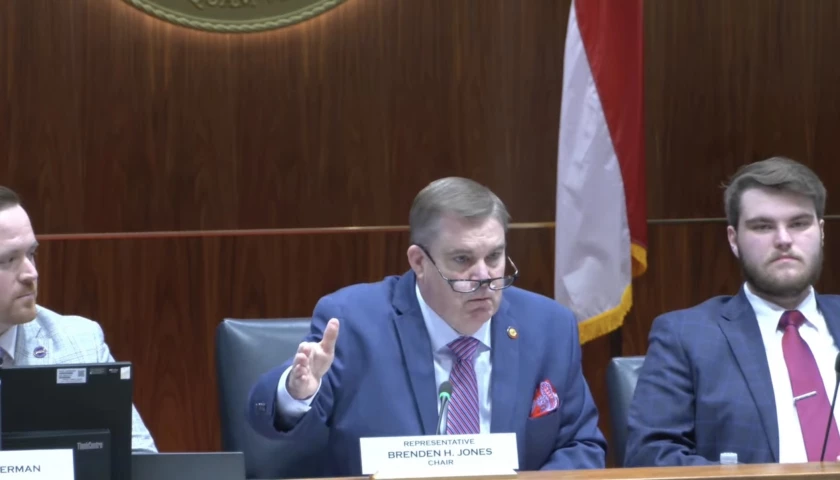
Those remarks caught the attention of House Majority Leader Brenden Jones, R-Columbus, who chairs the House Oversight and Reform Committee. The committee initiated a hearing, and requested documents from the school district.
"You deleted parts of the Parent Bill of Rights you didn't like for your public website. You published a weak staff guidance memo instead of a formal board policy just so you could dodge accountability. This wasn't passive resistance, it was a coordinated middle finger to the legislature and to every parent in your district," Jones said Wednesday.
What is Chapel Hill-Carrboro Schools' policy?
Griffin and Trice maintained in their responses that, contrary to Griffin's September remarks, Chapel Hill-Carrboro City Schools are abiding by the Parents' Bill of Rights, even the sections that the district's board members believe are discriminatory.
During Wednesday's hearing, Griffin said that he hoped to apologize for "any misunderstanding" his remarks could have caused.
The school district's policies, Griffin wrote, explicitly prohibit instruction on gender identity, sexuality and sexual activity between kindergarten and fourth grade.
"Our curriculum is consistent with state standards and complies with state and federal law," Griffin wrote.

The law defines the prohibition on discussion about gender identity and sexuality as extending to a district's core curriculum, supplemental instruction, textbooks and other supplemental materials.
In his written testimony, Superintendent Trice told lawmakers that while the district's formal Parents' Bill of Rights policy did not address the requirement that parents be informed before teachers started calling their child by a different name or using different pronouns, guidance issued to educators and staff did.
That procedure describes the conversation teachers or staff should have with the student requesting the change. That includes mentioning the state law's requirement that the school notify their parents, asking if they've discussed it with their parents and then asking if the student has any concerns about their parents learning about the request from the school employee.
What comes next?
Still, it was clear that Republican lawmakers were frustrated throughout Wednesday's hearing. They felt strongly that the Chapel Hill-Carrboro Schools policy intentionally disregarded the controversial parts of the Parents Bill of Rights.
Jones pointed to an email he said he'd been forwarded by the mother of a middle schooler who didn't know their child was being referred to by a different name until seeing their eighth-grade diploma. The parent wrote that they encouraged their child's exploration of their gender but that the school's "hyper-affirmative approach" drove a wedge between the child and their parents.
"Sounds like to me that the parents weren't notified, that they had to find out on their own," Jones said.
Trice said that he hadn't seen the email, which was addressed to the school board members.
"Parents are essential partners and, as we stated, it's important that we follow the law as written," Trice said, adding that parents need to be consulted before name and pronoun changes are approved.
The district's policies could result in updated legislation as soon as during next year's short session, Rep. Jeff McNeely, R-Iredell, told Griffin and Trice.
That legislation could, McNeely suggested, give the state the power to withhold funding from school districts that don't comply with the Parents Bill of Rights.
"Because of y'all, there's going to be legislation that comes, and it's going to be pretty tough because we're not going to put up with rogue school systems that have no money and will not comply with the laws of this state," McNeely said.
