

The North Carolina Senate approved legislation Wednesday that would prohibit local governments from allowing homeless encampments on public property and create enhanced penalties for some drug crimes committed near homeless service providers.
House Bill 437 would bar cities and counties from regularly allowing public camping or sleeping on public property, including parks, sidewalks, public buildings and rights-of-way. Supporters said the bill will improve public safety, while critics argue it prioritizes enforcement over long-term solutions.
The bill allows local governments to establish designated camping areas if they can demonstrate that there aren’t enough beds in local shelters. The designated campsites must also meet state requirements related to sanitation, safety and access to behavioral health resources.
The legislation would also create "drug-free homeless service zones" around shelters and certain homeless service facilities, making some drug offenses committed within those areas felonies.
Sen. Brad Overcash (R-Belmont) said the measure responds to the growing number of homeless encampments in communities across North Carolina.
"In the last few years, we have seen in every region of this state a proliferation of homeless encampments in our large cities, in our small towns and everything in between," Overcash said during Wednesday’s floor debate. "This has caused a public safety crisis. It has harmed our economic vitality and our small businesses, and it has also harmed the dignity of our homeless citizens."
Changed from its original form, which was more restrictive, the bill reflects frustration expressed by businesses about there being more people experiencing homelessness in the business districts. That frustration is in tension with what advocates say is a profound lack of affordable housing paired with rising costs and stagnant wages.
Fear of future lawsuits
Under the bill, local governments would be prohibited from authorizing or allowing ongoing encampments on public property. However, communities that show they lack sufficient shelter beds could designate areas where people experiencing homelessness may stay, provided the sites meet state standards and offer access to necessities such as restrooms and running water.
To enforce the law, residents, business owners and the attorney general could seek court injunctions against local governments that fail to comply. Before filing a lawsuit, individuals would be required to notify the local government and allow time for the alleged violation to be addressed.
Sen. Julie Mayfield (D-Asheville) raised concerns that the bill would burden local governments, pointing to numerous lawsuits in Asheville, which has a large and visible population of homeless people. The bill allows the local government 15 days to respond to instances of public camping after being notified by a business owner or resident.
"Please do not listen to the scare tactics on this," Overcash said of the concern. "This is about dignity, this is about safety, and this is about economic vitality."
Mayfield acknowledged that Overcash had successfully submitted an amendment to the bill that removed permanent supportive housing facilities from the drug-free zone provision.
Still, Mayfield questioned the enforceability of certain provisions of the bill.
“Who's going to bring charges against the organization? Is somebody going to actually walk down to the police station, file a report?” Mayfield asked NC Health News. “The police are going to come investigate, they're going to file charges and the DA is going to prosecute that case? I mean to some degree, I feel like this is a little ‘all hat, no cattle.’”
Ongoing housing crisis
Mayfield said the legislation lacks investments in housing and services that have been shown to reduce homelessness and improve public safety. While discussing the bill on the Senate floor, she pointed to permanent supportive housing developments in Asheville that pair housing with mental health services, case management and other supports.
Asheville, in particular, has struggled with housing affordability; the popular tourist destination has seen many units converted to short-term rentals and second homes.
Sen. Mujtaba Mohammed (D-Charlotte) said the legislation treats homelessness as a visibility issue rather than addressing the circumstances that lead people to lose housing.
"Homelessness is not a tent. Homelessness is a person," Mohammed said. "What this bill does is tell struggling people where they cannot be. What it fails to do is help them get where they need to be."
The discussion comes as the federal government is overhauling how it distributes funding to address homelessness. The U.S. Department of Housing and Urban Development's $4.04 billion Continuum of Care grant program for fiscal year 2026 shifts its emphasis from the long-standing "Housing First" model, which emphasized getting people into housing before addressing mental health and substance use issues and had seen strong results. Instead, federal officials are moving toward emphasizing the primacy of recovery, addiction treatment and self-sufficiency.
While local governments and service providers will be able to compete for the federal funding, grants are not guaranteed. Applications are due in August 2026, and advocates familiar with the program say awards are not expected to be distributed until late 2027.
Mayfield said that uncertainty makes it difficult to view future federal funding pointed out by bill sponsors as a solution for the responsibilities created under House Bill 437.
"We're just seeing an increased criminalization of lots of things. We increase penalties for things all the time, create new felonies, like this bill does. There is a general ethos of Republicans losing patience with our safety net and the people who that safety net are trying to serve," Mayfield told NC Health News. "They're losing patience with poor people, they're losing patience with people who are drug addicted, they're just losing patience, but they're not putting any money or solutions on the table."
National parallels
The debate comes as North Carolina grapples with rising homelessness and, in the western part of the state, the lingering effects of Hurricane Helene.
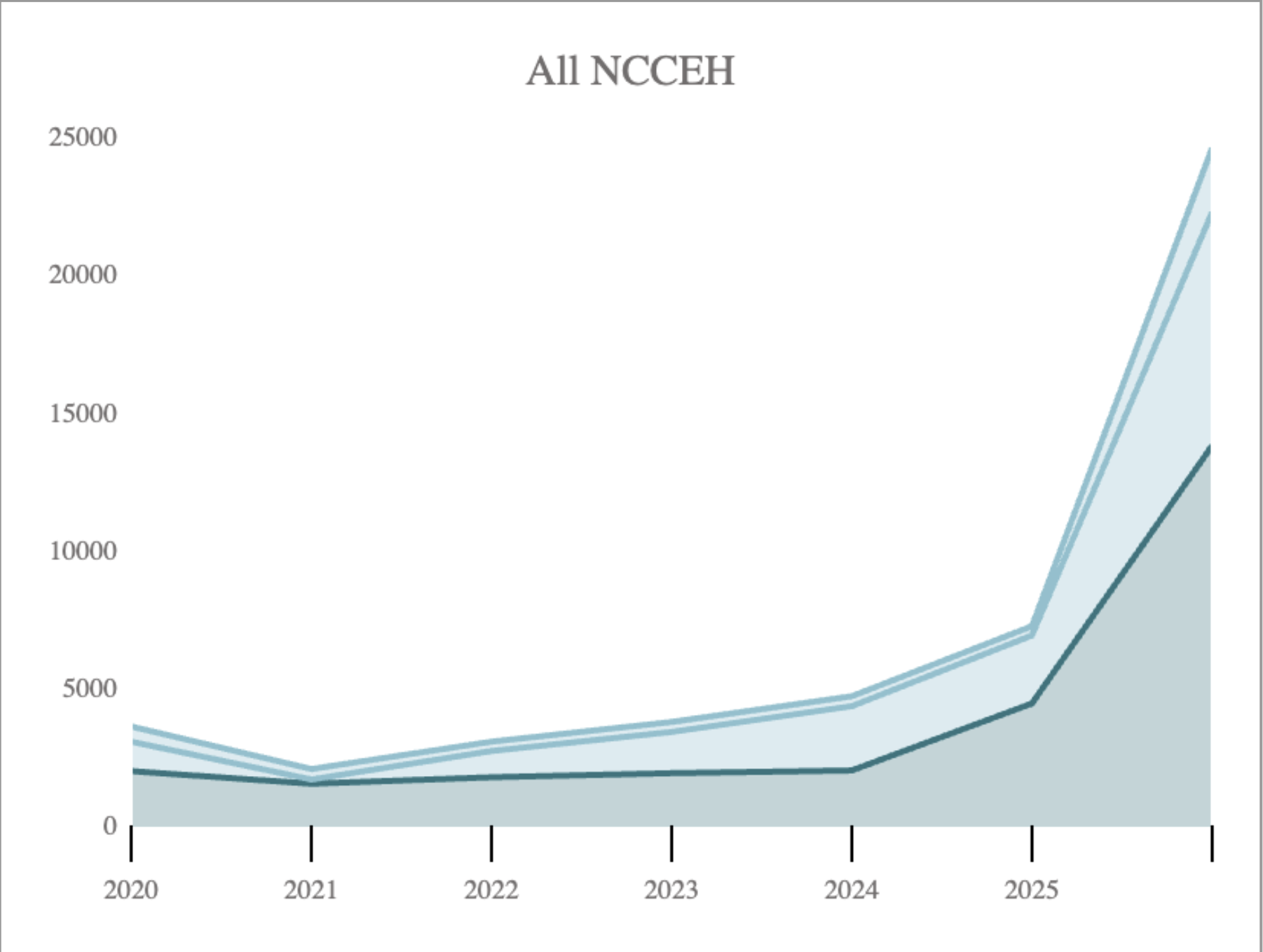
According to advocates, nearly 4,000 more people were counted during North Carolina's 2025 Point-in-Time count than the year before. The count is an annual tally of the number of people who lack shelter in communities across the state. While informative, the census tends to undercount people who “couch surf” or who are temporarily in jails and hospitals.
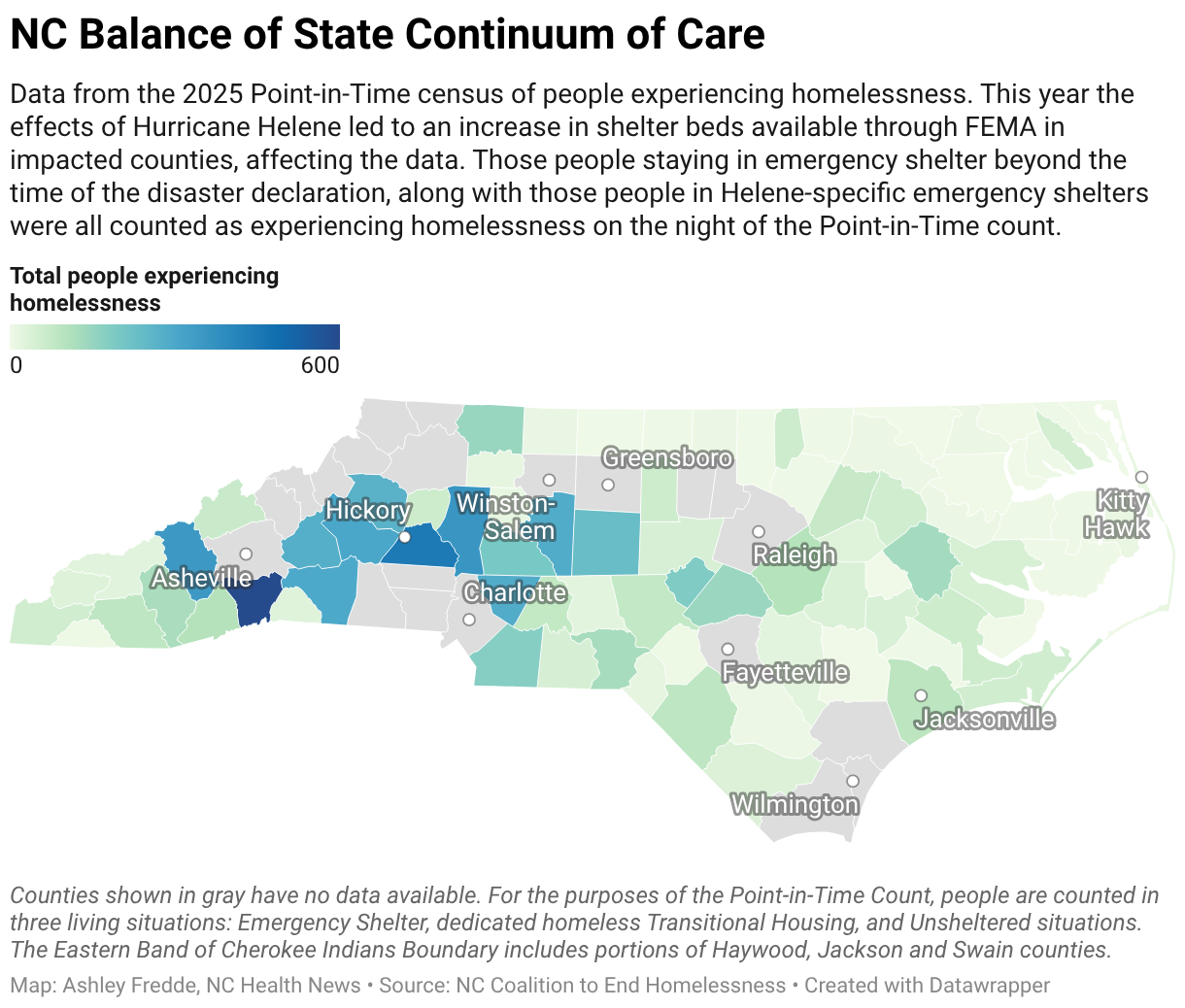
Advocates also think Helene contributed to what housing organizations have described as one of the nation's largest year-over-year increases in homelessness. Overall, the state reported 15,512 people experiencing homelessness in 2025. The storm damaged or destroyed tens of thousands of homes across western North Carolina.
Latonya Agard, executive director of the North Carolina Coalition to End Homelessness, said during a recent North Carolina Housing Coalition call that temporary shelter programs operated by organizations such as FEMA and the Red Cross were included in the annual count as residents sought housing after the storm.
"Many of those folks were counted because of Hurricane Helene," Agard said.
While the increase reflects an extraordinary disaster event, Agard said the effects of the storm are likely to be visible for years as families keep rebuilding homes and communities.
"We know that unfortunately when the headlines change, often our priorities change," she said. "People forget, but it's hard to not realize that our western North Carolina neighbors still need a lot of support."
Advocates on that call also pointed to rising housing costs, stagnant wages and uncertainty about federal and state funding streams as factors driving housing instability across North Carolina.
"Programs are still not funded as well as they should be funded, and so homelessness remains at a near all-time historic high for many reasons," Agard said.
She said those challenges are especially pronounced in North Carolina's rural areas, where there are often fewer shelters, fewer behavioral health providers and fewer resources to respond to people experiencing homelessness.
After recently driving through rural parts of the state, Agard said she was struck by the level of economic distress she encountered.
"I saw so many areas that were economically depressed, lots of homes boarded up, lots of buildings abandoned in incredible economic need," she said. "What I've learned also is that what we see in urban and rural is very different, but my eyes are continuing to be opened, and I see a greater level of need and a need to be more innovative, especially in our rural communities."
Housing advocates say those disparities are one reason they worry House Bill 437 could place new responsibilities on local governments without providing the resources needed to carry them out.
Liz Carbone, director of public policy and communications for the North Carolina Coalition to End Homelessness, said many rural counties lack the administrative capacity and the homelessness infrastructure envisioned by the legislation.
If local governments choose to establish designated camping areas, Carbone said they would be responsible for funding sanitation, staffing, law enforcement, public safety measures and coordination with behavioral health providers. For many communities, she said, simply identifying an appropriate location would be a significant challenge.
"There is language in the legislation about where these designated areas can be placed," Carbone said. "If you think of a county like New Hanover, where land was scarce 15 years ago, tell me where we could stick something like this where it wouldn't be in someone's backyard or next to their business."
Rather than creating new enforcement requirements, Carbone said, lawmakers should focus on preventing homelessness by expanding affordable housing and strengthening local support systems.
"Anything that focuses on criminalizing someone having no safe place to be, instead of thinking about how to make our communities more resilient to affordability challenges, that's just a nonstarter for us," she said.
This article first appeared on North Carolina Health News and is republished here under a Creative Commons Attribution-NoDerivatives 4.0 International License.