

On a sunny morning in late June, local horticulture agent Sarah Richardson gets ready to measure how much salt is in the water of Edenton Bay, which is part of the Albemarle Sound. With one hand she throws the measuring cable into the water, and with the other she checks the device screen.
“So the reading today is 4.6,” said Richardson, who works with the North Carolina Cooperative Extension.
That reading — 4.6 parts per thousand — is over ten times higher than the maximum level she recommends farmers use for irrigating crops. Usually irrigation systems connected to rivers or wells help farmers make sure crops get enough water during drought.
But as drought conditions persist across North Carolina, farmers in the Albemarle Sound are seeing an interesting trend: high salt content in freshwater coming from the Sound because of a lack of rainfall.


Freshwater like the Edenton Bay or the Chowan River drains out into the Albemarle Sound, which is saltwater. Normally, rainfall and snow melt from the mountains in western Virginia or North Carolina produce enough freshwater to keep the saltwater away.
But with the state’s drought reaching almost a year, there hasn’t been a lot of rain or snow. This past winter was the driest winter in North Carolina in 25 years, according to the State Climate Office.
“Our salt problems are mainly coming from a lack of annual winter rainfall,” said Richardson.
It’s a problem to irrigate crops with water that’s too salty because it makes it harder for the roots of a crop to absorb water and other nutrients.
“In severe cases, you can see where the soil actually starts to crack,” said Richardson. “You could have salt-affected soils that could stay there for up to 10 years. It really depends on the good quality rainfall that you get to help leach that salt out of the soil.”
'We have to be resilient'
In neighboring Bertie County, farmer Norman Perry, 76, is dealing with this issue first hand. This year is his 51st crop season. He stands on the banks of the Chowan River.
“The water is giving us a fit,” said Perry, with a light chuckle. “It’s too salty.”
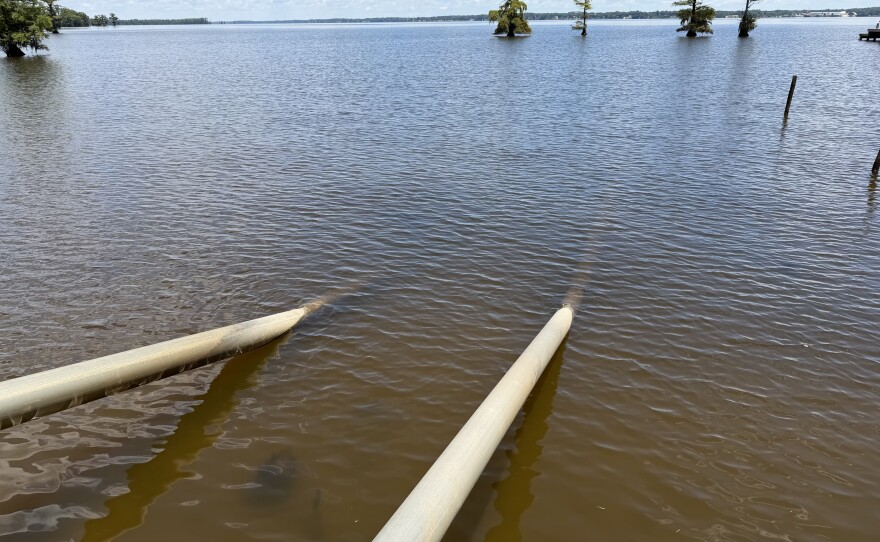
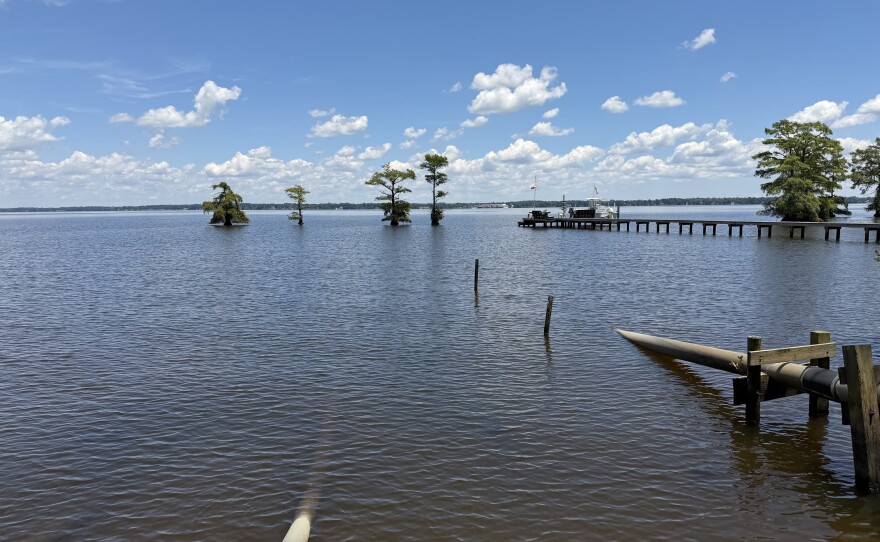
Perry uses the Chowan River to irrigate about a quarter of his 2,000-acre farm. He points to three pumps connected to pipes that run about 120 feet into the river.
“That one pumps 1,750 gallons of water a minute into a pond and we pump (it) out of the pond,” said Perry. “That one goes to a dedicated pivot, and that one goes to a dedicated pivot.”
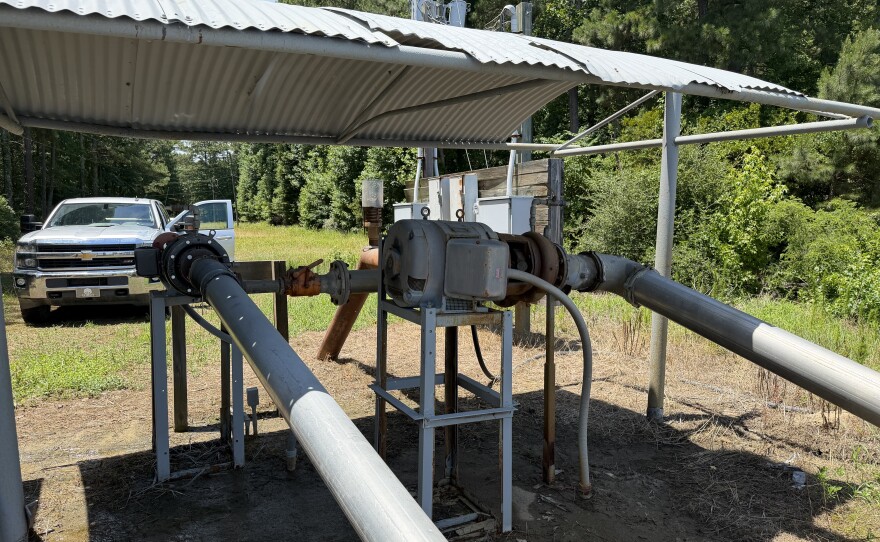
Pivot refers to his center pivot irrigation system, which he’s had since 1984. He and his son Free grow several crops, including cotton, peanuts, cucumbers, soybean and corn.
Each crop can handle different levels of salinity. Of the crops Perry grows, he says cotton is the least sensitive, while peanuts are the most. Their irrigation system helps them keep track of how much water is put on which crop.
But there’s only so much they can do without rainfall.
“We have to be resilient and deal the cards we’re dealt,” said Free.
He points to a field down the road.
“We’ve planted half of (that) field in cucumbers, but we had to stop because salinity has gotten too high,” said Free. “(We) might not be able to finish planting the field.”
In a corn field, Perry stands looking around at the growing stalks.
“This corn is okay. It’s been irrigated. It’s gonna be alright,” said Perry.
But on the other side of the same corn field are stalks that haven’t been irrigated, or received any rainfall.
“That’s gone,” said Perry. “When it gets yellow all the way to the top - forget it.”


Despite the extraordinarily dry conditions, Perry still maintains respect for Mother Nature.
“Mother Nature is your friend, but she can be a very bad friend sometimes,” said Perry. “ We can’t control (her) ... so we do the best we can.”
Farmers across N.C. feeling drought effects
Across the state, farmers are seeing impacts like ponds drying up. Ponds are water reservoirs farmers make for times like these. Brad Thompson, an agronomist with the state department of agriculture, covers seven counties in central North Carolina, including Chatham and Moore counties.
“I grew up in the Sandhills of North Carolina,” said Thompson. “I’ve seen ponds get low. I’ve never seen it where ponds aren’t refilling. So this is something that’s not normal for North Carolina.”

Another uncommon impact: Farmers are feeding cattle and sheep hay because there’s no grass for those animals to eat because it’s so dry. This high demand is causing the price of hay to increase. The price is also going up because of low supply. The same dry conditions that are causing little grazing land are also causing low hay production.
“That will start putting pressure on farmers to sell off livestock,” said Thompson. “Right now, the price of beef is fairly high. If everybody decides they can’t feed those animals, they’ll start shipping them off to be slaughtered for meat, and that will drop the price of meat down. Then the farmers won't be getting as much for the animal as they need to make a profit.”
All these factors are creating financial challenges for farmers. Even on a good year, farms have razor thin profits.
“The cost of fuel, seed, fertilizer, herbicides and equipment have all increased significantly,” said Thompson. “So you (have) all that, and then you have the drought.”
A drought that doesn’t seem to be ending anytime soon.
Seven counties in central North Carolina remain in exceptional drought, along with Brunswick County near Wilmington. The North Carolina Drought Management Advisory Council says that’s when daily life is affected for all citizens and people begin to pray for rain.
